The AI Trap: Speed vs. Skill
I recently read a few articles by developers explaining why they stopped using AI code editors. Lately, the “honeymoon phase” with AI coding seems to be over, and I’ve started to rethink my own workflow. I agree with the critics, especially on one point: the feeling of losing the ability to “code on my own”.
The Good: Higher Level Thinking
AI is an incredible accelerator. It allows me to move away from the “boilerplate” and focus more on software architecture. It’s great for:
- Debugging faster (spotting typos or obvious logic errors).
- Writing quick POCs.
- Creating documentation.
It feels like using a high-level language. You don’t always need to know what the assembly code is doing if the compiler is good. But coding isn’t just about compiling; it’s about solving problems.
The Bad: The “Polite” Hallucination Loop
We all know the pattern. AI makes a mistake, you point it out, and it replies with:
- “Oh, you are absolutely right!”
- “I apologize for the confusion…”
- “My mistake, let me correct that for you.”
- …
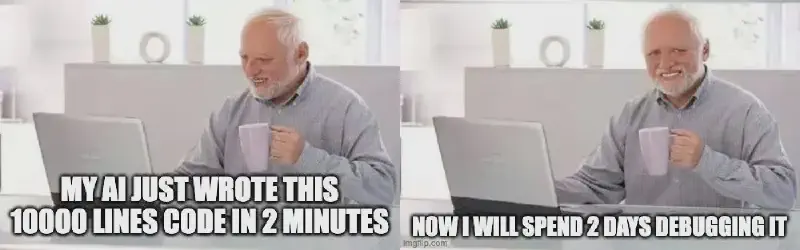
This loop is dangerous. When I use AI too much, I start losing my algorithmic intuition. Sometimes, I find myself waiting for the AI to fix a bug that I could have solved myself in half the time if I had just looked at the code. I’ve developed a “lazy brain” pattern—I trust the tool more than my own experience.

The “Almost-Right” Image Problem
Coding with AI lately feels like generating images. You ask for a picture, and the AI gives you 20 “almost good” versions. But the moment you want to fix a specific detail—like the shape of a hand or a specific shadow—it starts to fall apart.
The AI gives you something that is 90% there, but that last 10% is often a massive pain. It’s exactly the same with code. The AI generates a function that looks perfect, but when you need to tweak a very specific edge case, the AI starts hallucinating. At that point, you need to know when to stop prompting and open “the old-school Photoshop” (your own brain) to fix the pixels manually.
The Risk: Owning Code You Didn’t Write
The real trouble starts when things break. When you build a house using pre-made parts you don’t understand, you can’t fix the foundation when it cracks.
I’ve realized that I often find more efficient solutions than the AI, but only when I force myself to stop using it. The AI often gives you the “average” solution, not the best one.
Conclusion
I’m not deleting my AI tools yet, but I am changing how I use them.
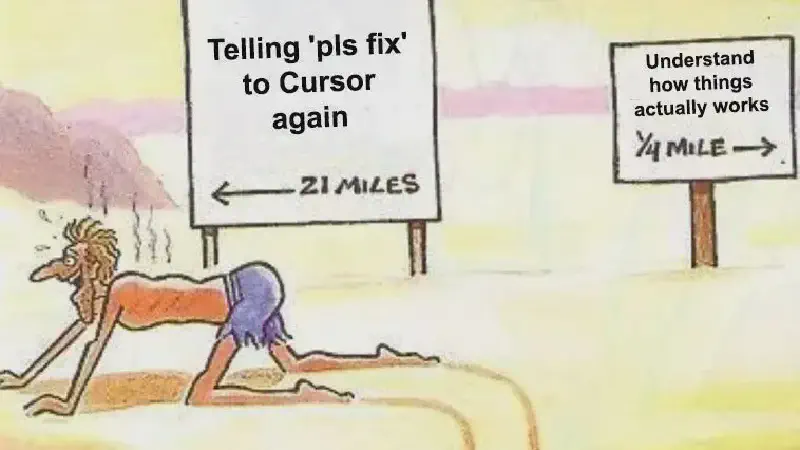
AI should be a junior assistant, not the lead architect. If we stop practicing the core skill of thinking through algorithms, we become observers of our own code. We need to stay critical, stay manual when it matters, and most importantly, stay in control.